
Guideline
Guidelines for the Rescue, Rehabilitation Release and Post-release Monitoring of Andean Bears
These guidelines were written by Armando X. Castellanos P., David A. Jackson and Dr. J. Leonardo Arias C. of the Andean Bear Foundation and published in Quito, Ecuador, in 2016. This is the second edition. It draws on 20 years of rescue, rehabilitation and release work in Ecuador, during which 21 Andean bears (11 females and 10 males) were returned to their native habitat, as well as the capture and monitoring of 23 wild bears and the captive management of more than 70 individuals in rescue centres and zoos. The first Andean bear reintroduction took place in Ecuador in 1995, following the IUCN reintroduction guidelines.
Andean bear biology and ecology
The first part of the guide describes the species itself. The Andean bear (Tremarctos ornatus) is the only bear in South America and the only living member of the short-faced bears, the Tremarctinae. It ranges from western Venezuela through Colombia, Ecuador and Peru to Bolivia, living in cloud forest and páramo. The guide covers body size, life expectancy, blood values and genetics, then behaviour: activity patterns, home range and movement, nest building, diet and feeding, reproduction and denning, communication and marking. It also explains the bear's role in the ecosystem. Low reproductive rates and long parental care make the species highly sensitive to habitat loss, and the authors estimate no more than 20,000 remain in the wild, fewer than 3,000 of them in Ecuador. The species is listed as Vulnerable on the IUCN Red List and appears on CITES Appendix I.
Rescue, rehabilitation and release
The second part is a step-by-step manual. It covers project planning, permits and community participation; rescue protocol, veterinary care and the criteria for selecting bears for rehabilitation; transport and immobilization; and the design of rehabilitation enclosures for cubs and adults in both cloud forest and páramo. A chapter on feeding sets out a cub milk formula and the move from provided food to natural plants, fruit and animal protein. The release chapters deal with exclusion criteria, hard and soft release (the authors recommend hard release), release site assessment, marking, timing and helicopter transport.
The final chapters cover post-release monitoring by radio, GPS and satellite telemetry, how to judge whether a release has succeeded, and what to do when it has not, including relocation and recapture with the Iznachi trap. Captive breeding, care of elderly bears and necropsy are also addressed. Appendices give reference blood values, a list of common illnesses, intake and medical record forms, a necropsy report template and an index of wild foods with captive alternatives.
Browse all guidelines.
More guidelines
- IUCN Guidelines for amphibian reintroductions and other conservation translocations
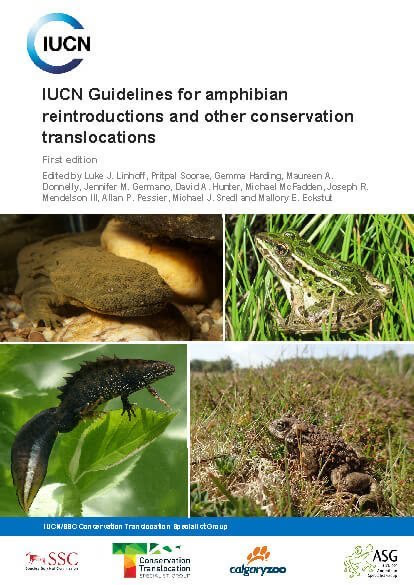
 11.6 MB
- Guidelines for Reintroductions and Other Conservation Translocations
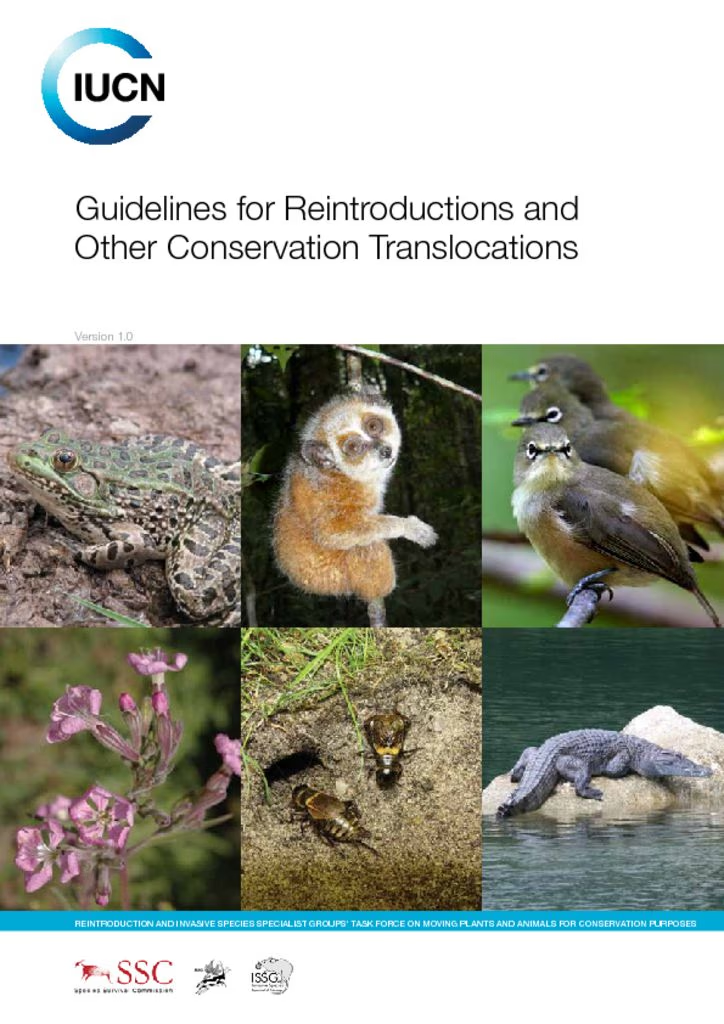 495 KB
- Guidelines for the In-situ Translocation of the African Elephant for Conservation Purposes
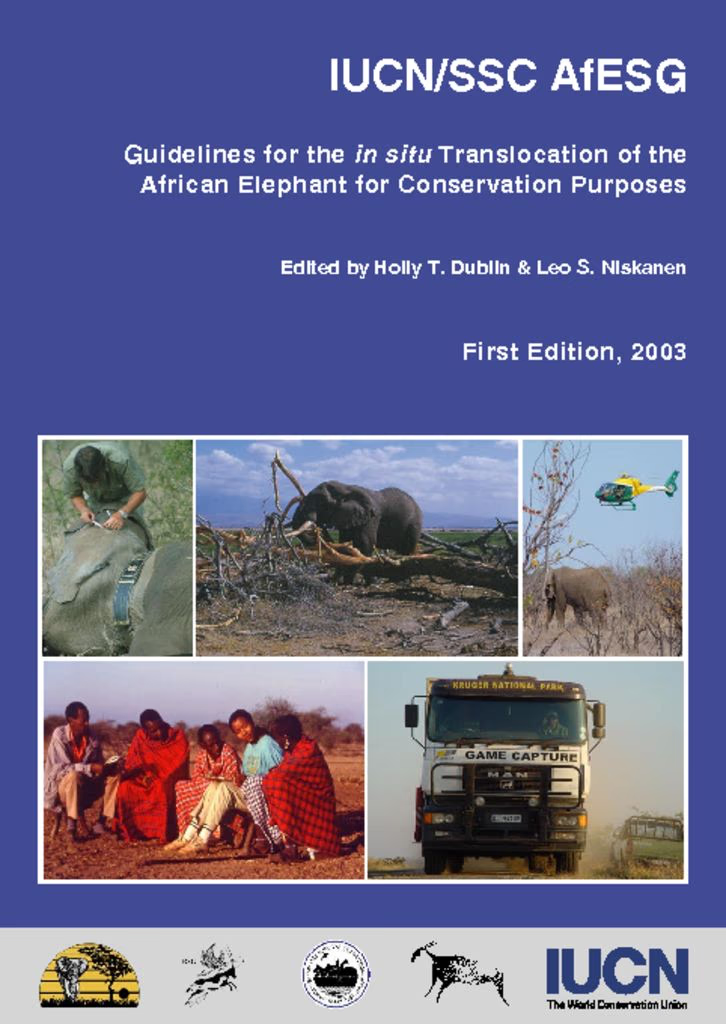 762 KB
- Guidelines for Reintroduction of Galliforms for Conservation Purposes
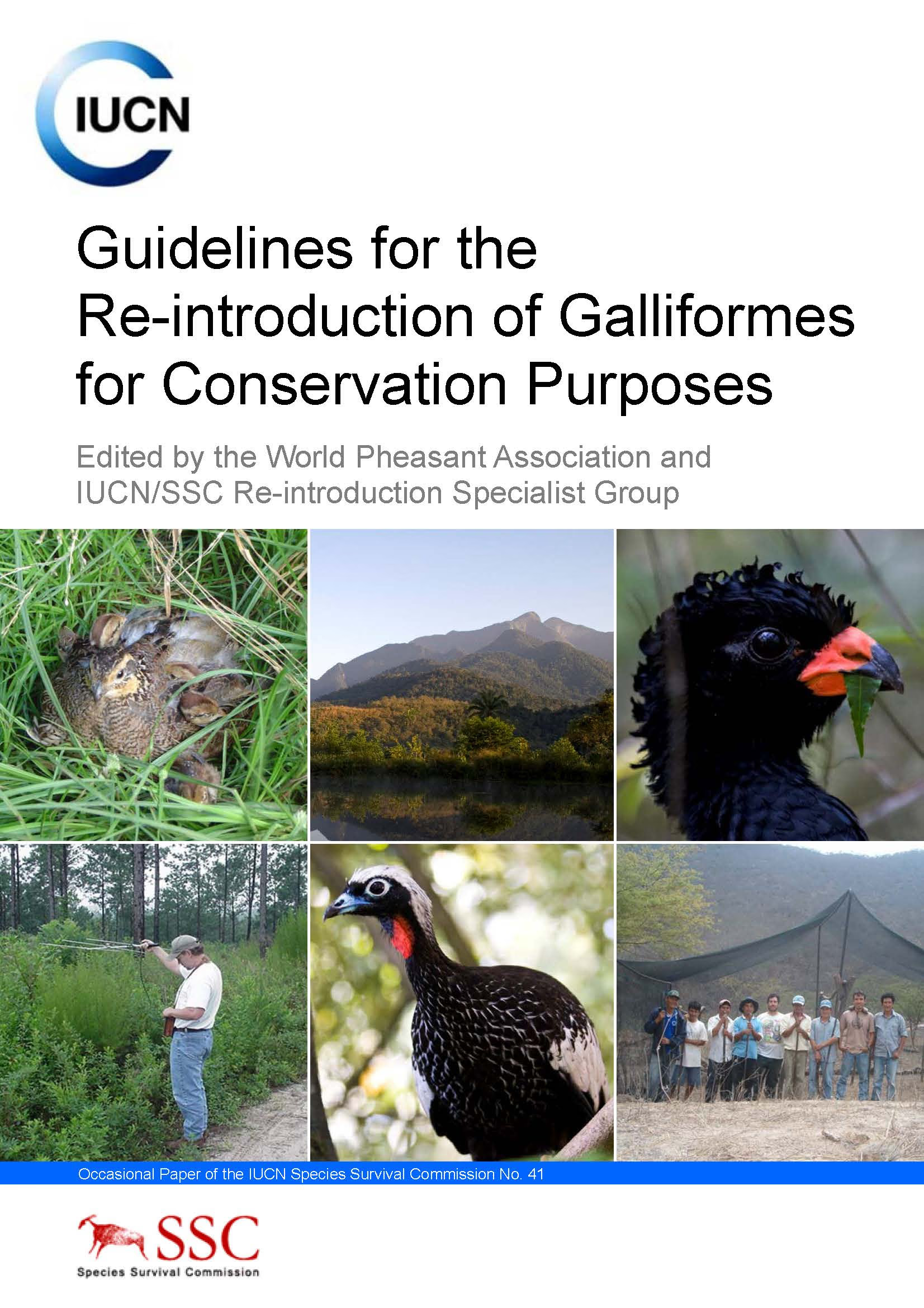 2.3 MB
Frequently asked questions
What are IUCN SSC guidelines?
IUCN Species Survival Commission guidelines are technical guidance written by specialist groups for people who plan and carry out conservation work. They are guidance rather than law, but governments and zoo associations have adopted the core reintroduction guidelines into their own policies. The IUCN SSC Re-introduction Specialist Group (RSG) was founded in 1988 as one of the specialist groups of the IUCN Species Survival Commission. It is now called the Conservation Translocation Specialist Group (CTSG). Its original reintroduction guidelines became official IUCN policy in 1995.
Which other guidelines are in the library?
This site holds 10 guidelines and 8 translated editions of the core guidelines. Besides Guidelines for the Rescue, Rehabilitation Release and Post-release Monitoring of Andean Bears, the guidelines are IUCN Guidelines for amphibian reintroductions and other conservation translocations, Guidelines for Reintroductions and Other Conservation Translocations, Guidelines for the In-situ Translocation of the African Elephant for Conservation Purposes, Guidelines for Reintroduction of Galliforms for Conservation Purposes, Guidelines for Re-establishing Grey Partridges Through Releasing, Guidelines for Nonhuman Primate Reintroductions, Guidelines for the Rehabilitation and Translocation of Gibbons, Guidelines for the Reintroduction of Great Apes and IUCN Guidelines for the Placement of Confiscated Animals.
In which languages is it available?
This document is published in English on this site. The 8 translations here cover the core IUCN Guidelines for Reintroductions and Other Conservation Translocations, in Arabic, Chinese, Czech, French, Korean, Portuguese, Russian and Spanish.
Is it free to download, and can I reuse it?
The PDF is free to download, with no login or fee. The file is 6.3 MB. Many IUCN publications allow reproduction for educational or other non-commercial purposes with full acknowledgement of the source. Each PDF states its own citation and reuse terms on its title or copyright page, so use that wording where one is given.
How should I cite Guidelines for the Rescue, Rehabilitation Release and Post-release Monitoring of Andean Bears?
Use the citation printed in the document where one is given, and add the address of this page if you are citing the web version: https://www.iucn-ctsg.org/project/andean-bear-rehabilitation-guidelines/.